Find and see the best corporate environmental sustainability news, posts and stories here, at Edenark Group’s “IN THE NEWS.” Let us know if you have environmental sustainability news you would like us to add.
The Rising Tide of Environmental Class Actions
This article focuses on Canada, but explains that environmental class actions are on the rise everywhere.
If you are talking about your environmental actions, or if your business is negatively impacting the environment materially, you are at risk.
We recommend all company leaders review this post, watch this podcast on greenwashing, read this on what you want in a sustainability program, watch this master class, and contact us.

Big Legal News in Corporate Sustainability
Per this article, many legal developments are in play around the world.
Greenwashing in Canada – Canada’s parliament has passed legislation (Bill C-59) that will require companies to prove the credibility of any environmental claims they make. It will require the company to provide “adequate and proper substantiation in accordance with an internationally recognized methodology” and the claims should be “based on an adequate and proper test.”
- Does the above sound familiar? For some time we have been advising companies that any claims not tied to a globally-recognized program that includes 3rd party verification put the company at risk.
Due Diligence in France – The Paris Court of Appeal ruled that cases against TotalEnergies and EDF could proceed. These cases say the companies did not monitor and mitigate the human rights and environmental impact of their business activities AND supply chains.
- Remember the ‘supply chain’ component of this. You will see more supply chain vendors pulled into environmental disputes where the initial lawsuit is against the big client company; but is expanded to include the vendor for not having a sustainability program and not protecting the environment.
Shareholder Proposals in the US – A US judge dismissed a case brought by Exxon against a shareholder group that is attempting to get Exxon to be more proactive regarding its Scope 3 emissions (ie, remember, Scope 3 includes you, the vendor). The Judge dismissed the suit due to the shareholder group not being American (the group is Dutch).
- You will see more and more of this. Environmental shareholder groups will form in obscure areas (such as South Pacific island countries fearing rising sea levels) to avoid defensive actions by the companies they are trying to influence.
Scope 3 Emissions in the UK – The UK Supreme Court ruled that local authorities must consider Scope 3 emissions of projects when deciding to permit them.
- Let this one soak in. Going forward, any entity seeking a business permit in the UK will face scrutiny over how it is going to manage its Scope 3 emissions (which, again, includes you, its vendor). Think of the opportunity this presents for vendors who are environmentally certified sustainable in helping prospects/clients secure permits for expansion.
Overall Trend – The world is rapidly advancing environmental compliance programs and the penalties for non-compliance.
- If your company has self-certified its sustainability efforts, we strongly recommend halting all claims until you have become certified under a globally-respected program with 3rd party verification.
- If your company has no formalized/verified sustainability program, re-read the above statements on Scope 3. Even if you choose to not make any sustainability claims and hide under a rock, you will not avoid what is coming. The less prepared you are, the greater risk you carry.
If you wish to use this to your advantage, read this on what you want in a sustainability program, watch this master class, and contact us.
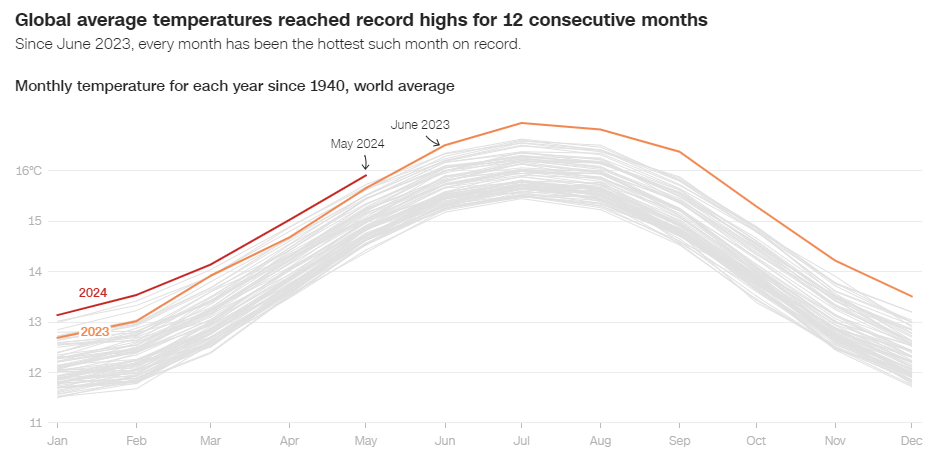
Are you Getting Hot about Being Hot?
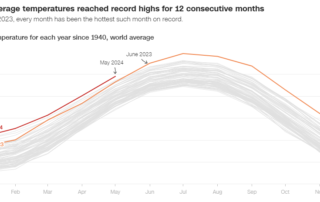
Global average temperatures reached record highs for the past 12 consecutive months.
Brace yourself, as she’s just warming up….

Have you considered becoming a referral partner?
Due to studies, the #1 issue on the minds of people around the world is the environment (ie, we are using our resources faster than Mother Earth can replenish and we are accelerating our carbon-emissions-driven global warming). The world we are passing to our children will be far hotter and angrier than the world we were given. This is a bigger concern to the people of the planet than war, economy, politics, et cetera.
Turning this sentiment to the market place, consumers are more interested in a company’s ability to prove its sustainability commitment than they are in its brand names. 7 out of 10 of them will change brands if they find a certified sustainable company that offers a similar product. They will even spend more for a certified sustainable product.
Driven by the above demand, certified sustainable companies are growing up to 20x faster than their non-certified peers – the market is rewarding companies that are able to prove they are sustainable (via certification/validation).
The Edenark Group ISO 14001 environmental sustainability certification program is the premier program of its kind in the world – You get to help the planet and differentiate and grow faster than your peers.
We have a 100% client renewal rate – every client we have ever certified has renewed, every year.
We get most of our new clients from referrals from existing clients.
However, we also get a good number of clients from referral partners who like what we do and introduce us to organizations they feel would benefit from our services.
This defines what we believe a sustainability program should contain.
This master class explains why a company would want to do this.
We are looking for organizations that 1) care about the environment; 2) want to be part of the solution; and 3) want to be an example that other organizations can follow.
If you agree with our mission and our definition of what a sustainability program should be; and if you know some organizations that meet the above requirements; you might want to consider becoming a referral partner.
Send us a note and we can discuss.
What should an environmental sustainability program include?
Per this master class, there are 8 components of a sustainability program that will be successful and make you happy:
- It MUST include Employee Performance / Health
- Sustainability is not just about energy savings or ‘Greening Up’, it is about people
- For most businesses, the employees are one of the biggest costs, one of the biggest risks (mistakes, insurance, law suits) and one of the biggest opportunities (new ideas, collaboration, product knowledge)
- Every organization suffers from the Big 5 – insomnia, stress, anxiety, physical pain, mental acuity
- You are losing 5% of your corporate profit/year to the Big 5
- It takes a lot of LEDs to make up for one worker comp or workplace violence case
- Make sure your program has a ‘people piece’ that addresses employee performance, health and happiness
- It MUST certify the business not the box
- People care about things that involve people
- Most building (ie, ‘Box’) certifications only care about building energy
- Building certifications are expensive and hard to market (poor ROI)
- You want to say, “Buy more of my product because we are a certified sustainable business”
- You do not get much value from, “Buy more of my product because we are in an energy efficient building”
- You want the certification on your business, not the building your business is in
- It MUST have a 3rd party audit component
- Oversight delivers credibility and trust
- From passing your driving test, to getting your college diploma, to passing a bar exam, we use 3rd parties to ensure compliance
- There are many sustainability programs that deliver a certification based on your ‘word’…..and your payment
- Don’t do it!
- Make sure the program you choose uses a 3rd party to validate your work
- It MUST follow a respected and integrated global standard
- The sustainability industry is maturing and coalescing around few standards
- The UN has created its SDGs (17 sustainability development goals)
- 50% of the world’s economies require sustainability reporting
- Greenwashing lawsuits are growing
- Don’t pick a program that is not globally respected by, and integrated with, the world leadership groups; and that does not have the ability to integrate the other three legs of the stool – carbon neutrality, ESG and net zero
- No reason to spend the time and money, then find you are not following the same programs and protocols that the leadership groups have adopted
- It MUST include promotion of the certification
- Historically, sustainability has been a cost-side play
- Most programs and providers have been 100% trained and focused on cost-side measures – energy reduction, carbon reduction, waste reduction, water reduction, travel reduction (ie, engineering)
- But we know consumers are searching for certified sustainable companies
- If you don’t talk about being certified sustainable they will never know you are (ie, marketing)
- You want a program provider that is built to do the cost-side work AND the revenue-side work; and helps you promote your certification
- It MUST pursue continual improvement
- Sustainability is not finite. It requires long-term commitment
- But…change is hard for all of us
- If the bar is set too high, we can get frustrated and give up
- You want a program that lets you come as you are and allows you to continually improve
- This will keep everyone happy and committed year after year
- It MUST require annual updates
- Current = credible
- Sustainability is not finite; we need to continually improve
- You don’t want a program that does not have a date attached to its certification
- You want to continually improve, see your success, and annually update your certification to show you are current and credible in your actions
- It MUST be at a price you can afford and produce a positive ROI
- We could have started with cost but you need the above seven components at a price you can afford
- It needs to show a positive and rapid ROI
- The cost includes both money and time and covers everything – the certification, the 3rd party audit and your work to become certified
As stated, we deliver all eight components mentioned above to our clients.
We enjoy a 100% client renewal rate – every year, every client has a decision to make and every year, every client has renewed.
If you use a program that delivers all of the above, you will probably be happy too.
The CSDDD Presents Opportunity for Your Business
As this article explains, while the Corporate Sustainability Due Diligence Directive (Directive) mainly targets in-scope companies, it also offers significant opportunities for SME supply chain business partners of the in-scope companies.
Non-compliance with the Directive can result in competitive disadvantages for business partners, penalties for in-scope companies (which, depending on the contract and circumstances, could be passed on to business partners), interim measures and reputational harm through “naming and shaming”.
Conversely, aligning with the Directive’s standards could not only strengthen relationships with in-scope companies but could also set partners apart in a competitive market. Early adaptation and collaborative efforts towards compliance can mitigate risks and open new avenues to growth, underpinning the transition towards a more sustainable and accountable corporate ecosystem.
As we have explained in prior posts, sustainability reporting will continue to expand. Smaller businesses will soon be required to report.
The question for SME leaders – If you care about the environment and want to be part of the solution, do you proactively become certified sustainable or do you wait and see if your lack of action hurts your business?
If you wish to use this to your advantage, read this on what you want in a sustainability program, watch this master class, and contact us.
That didn’t take long
Yesterday, we reported on the CSRDDD (Directive) becoming law and how it will influence larger companies to seek SMEs that can help the larger company address its requirements under the Directive.
Per this, the EU markets regulator, the European Securities and Markets Authority (ESMA), advised by the European Financial Reporting Advisory Group (EFRAG), has now proposed that as part of the Directive, SMEs be required to report on positive sustainability impacts and opportunities to avoid greenwashing and improve access to lenders, investors and clients.
Those SMEs that are proactive and become certified sustainable, differentiating from their non-certified peers, will take market share, as the world transitions to environmental reporting.
If you wish to use this to your advantage, read this on what you want in a sustainability program, watch this master class, and contact us.
The CSDDD is Law – Why should you care?
On 24 May, 2024, the EU finalized its adoption of the Corporate Sustainability Due Diligence Directive (‘Directive’).
In effect, starting with larger companies, then expanding to smaller companies, the Directive requires companies do a number of things, beginning with the duty to:
- Identify, prevent, and mitigate actual and potential adverse impacts on people and the environment that result from either the entity’s own operations anywhere in the world (including subsidiaries) or from the operation of upstream and certain downstream business partners.
Why does this matter to you?
- Simply stated, via the “upstream and certain downstream business partners” language, these larger, (then later, smaller) organizations will be seeking vendors that help them address the Directive.
- Some large companies have thousands of vendors. They are already out of time in their attempt to satisfy the Directive.
If you prefer others to lead, ignore this.
If you care about the environment, see yourself as a leader, and want to take market share, watch this webinar and give us a call.
Are you exposed to a climate change lawsuit?
Climate change lawsuits continue to be on the rise. As this article explains, some states are now soliciting parties to file suit against entities like fossil fuel companies.
Is your company exposed?
- Are you making environmental claims or do you have an environmental mark in your logo or advertising….without being certified sustainable under a globally-respected program that includes 3rd party verification?
If you are exposed
- Stop your claims until you become certified sustainable and have 3rd party verification
- Then, only claim the things your certification allows
If you wish to benefit from market demand but do not want the risk of being exposed or greenwashing, read this on what you want in a sustainability program, watch this master class, and contact us.




18 Reasons Why Sustainability can be a Strategic Business Advantage
We like this list from the Forbes Business Council of 18 reasons why sustainability can be a strategic advantage for your business:
- It can set your business apart
- It indicates long-term viability
- It enables proactive responses to industry changes
- It provides a competitive edge
- It expands your target audience
- It can narrow the divide between large and small businesses
- It enables the surrounding ecosystem to thrive
- It brings your business in alignment with clients’ values
- It demonstrates care for more than profits
- It enhances business efficiency
- It can facilitate cost savings
- It enhances brand reputation
- It provides long-term financial benefits
- It can drive operational efficiency
- It enables risk mitigation
- It centers future buyers
- It grants access to innovative tech
- It strengthens the company’s reputation
However, we would add two to the very top:
- It is the right thing to do
- It allows your company to be part of the solution
If this list looks attractive, read this on what you want in a sustainability program, watch this master class, and contact us.