Find and see the best corporate environmental sustainability news, posts and stories here, at Edenark Group’s “IN THE NEWS.” Let us know if you have environmental sustainability news you would like us to add.

Are you achieving your 2026 budget so far?
2026 is 33% behind us!
We all forecasted a budget for the year.
Some of us are confident….and some of us are scratching our heads, wondering where the plan went wrong.
Per this study by University of California at Riverside, brands committed to sustainability are growing 4x faster than their non-sustainable peers. NYU/Stern says it is 7x. Symbola says 20x.
Further, 66% of consumers say they will pay more for sustainable brands.
What would higher prices and 4x sales have done for your 2026 plans?
What could it do for the rest of your year?
If this sounds interesting, read this on what you want in a sustainability program, watch this master class, and contact us.
What does the update to the world’s top sustainability standard mean to you?
The ISO 14001, which is the world’s largest and most respected environmental sustainability program, has received its latest update.
The last update, back in 2015, which created the ISO 14001:2015, allowed for usage of the standard in a broader mix of businesses.
The most recent update, the ISO 14001:2026, which came out last month, focuses more on the risks we face and the challenges businesses need to protect against. Changes include:
- The 2026 revision places a stronger emphasis on external environmental conditions. This will help organizations consider how things like climate change, biodiversity, and resource availability are impacted by the company’s actions; and how environmental conditions affect operations.
- The 2026 revision requires a stronger linkage between Stakeholder expectations and risk-based planning. This will help integrate environmental objectives into the planning and execution of the business objectives.
- The 2026 revision recognizes risks are rising and need more attention. This will help organizations better plan and manage changes that will affect the environment.
- The 2026 revision requires better documentation on key planning processes. This will help organizations better define and document processes for enhanced efficiency.
- The 2026 revision requires lifecycle thinking on external processes and activities it controls or influences. This will help organizations do a better job of establishing and managing supplier expectations on environmental matters.
For businesses looking to reduce expense and risk, and increase efficiency and profit, the new additions will improve what was already the world’s top tool.

Would you like 20 reasons why sustainability can be a strategic advantage for your business?
We like this list from the Forbes Business Council of 18 reasons why sustainability can be a strategic advantage for your business:
- It can set your business apart
- It indicates long-term viability
- It enables proactive responses to industry changes
- It provides a competitive edge
- It expands your target audience
- It can narrow the divide between large and small businesses
- It enables the surrounding ecosystem to thrive
- It brings your business in alignment with clients’ values
- It demonstrates care for more than profits
- It enhances business efficiency
- It can facilitate cost savings
- It enhances brand reputation
- It provides long-term financial benefits
- It can drive operational efficiency
- It enables risk mitigation
- It centers future buyers
- It grants access to innovative tech
- It strengthens the company’s reputation
However, we would add two to the very top:
- It is the right thing to do
- It allows your company to be part of the solution
If this list looks attractive, read this on what you want in a sustainability program, watch this master class, and contact us.

Can you prove the green claims you are making?
Why do companies make environmental / green / sustainability claims?
- Because they know consumers overwhelmingly support companies that are eco-friendly.
Is consumer demand so great that a company will make claims, even if it knows they are not true?
- Per this, and other studies, 59% of executives admit their companies are greenwashing.
- Those same executives believe 75% of their peers are also greenwashing (which, they argue, is what is driving them to also exaggerate their achievements).
- 70% of Scope 3 figures are inaccurate.
What are these companies now facing?
- Government regulations are becoming tighter.
- Courts are becoming harsher.
- Activists are becoming more experienced.
- Fines and penalties are becoming larger.
- Environmental lawsuits have pierced the corporate barrier and are now going directly after directors and officers, individually.
There are a few solutions:
- Continue until caught and face the consequences.
- Remove all environmental claims from your communication and face the lost revenue.
- Become environmentally certified sustainable and have your advisor help you craft your communication within the parameters of the program you became certified under.
If this sounds interesting, read this on what you want in a sustainability program, watch this master class, and contact us.
What to look for in an environmental sustainability program?
The 8 Essential Components of an Effective Environmental Sustainability Program
In today’s business landscape, environmental responsibility is more than just a buzzword—it’s a vital part of a company’s success and reputation. Customers, investors, and employees are increasingly looking to engage with organizations that demonstrate a genuine commitment to sustainability.
But how do you find the right program and what to look for in an environmental sustainability program?
At Edenark Group, we specialize in not only helping you develop your commitment to sustainability via providing the top environmental sustainability certification program; but also helping you use and promote that certification, to stand out and grow.
As part of our service, we recommend everyone read this guide on what to look for in an environmental sustainability program.
You want to find a program, by us or someone else, that has the below eight key elements. These eight elements, in combination, form an effective sustainability certification program. If you find a program with these eight elements, we believe you will be happy and your business will be greatly enhanced.
1. The Program Must Prioritize Employee Well-Being and Performance
Sustainability starts with your team.
Your employees are your most valuable asset. Focusing on their health, happiness and performance not only boosts morale but also enhances productivity and reduces costs associated with illness, medical insurance, Worker’s Comp, absenteeism and turnover. Every company suffers from the Big 5 – worker insomnia, stress, anxiety, physical pain and mental acuity. The combined damage from the Big 5 on your profits is roughly 5% per year.
Benefits:
- A sustainability program that has a ‘people piece’ that addresses the Big 5 will help your team become happier, healthier and more productive.
- This will help your company become more profitable.
As to the Edenark Group Program:
- The Big 5: Our program has a people-piece that addresses the Big 5 and helps your employees become happier, healthier and more productive.
- Training and Development: We help you train your team on both sustainability and wellness programs.
- Profit: We help you develop and maintain a healthy work environment that will reduce the Big 5 and improve overall well-being; leading to increased profits.
2. The Program Must Certify Your Business, Not the Building
Focus on what the market is demanding; and what can positively impact your brand.
While the energy-efficiency of your building is critical to an overall environmental sustainability program, and our program includes it, it is not what consumers or governments, or any of your stakeholders, are wanting to hear from you on. They want to hear what your business is doing; they do not want to hear you talk about what the building you have space in is doing.
Benefits:
- Compliance: The various compliance programs that governments are turning into law will focus on your business, not the building you are in.
- Client Mandates: Your B2B clients will be demanding, via their Scope 3 requirements, that your business be sustainable. Their mandates will not tie directly to the building you have space in.
- Brand Enhancement: Position your company as a leader in environmental responsibility by focusing on your brand, not a building you are in.
- Customer Trust: Consumers want to hear directly from your company about what it is doing.
- Competitive Advantage: This allows your company to stand out in your industry by showcasing your efforts, not the efforts of the building you are in.
- Foundation for Other Programs: You may ultimately want to pursue carbon neutrality, net zero and ESG. If you want the flexibility to expand with these, you want to certify your business.
As to the Edenark Group Program:
- Business Certification: We certify your business.
- Compliances and Mandates: The program is designed to satisfy compliances and mandates, maximizing your benefit.
- Business-Wide Assessment: As part of your business certification, we evaluate all aspects of your operations, including the space you are in.
- Promotion of your Brand/Business: We help you use the certification to promote your business, not the building you are in.
3. The Program Must Include Independent Third-Party Verification Audits
Satisfy compliances and mandates; and build trust through transparency.
An effective sustainability certification must involve verification by an independent third party to ensure credibility. This process validates your efforts and assures stakeholders that your commitments are genuine.
Benefits:
- Greenwashing: Many companies, looking to cash in on consumer demand, are exaggerating their environmental sustainability claims (ie, greenwashing). You want to be removed from this.
- Compliance and Mandates: As your corporate clients and governments demand proof of your claims, 3rd party verification of your sustainability certification provides same.
- Brand Integrity: You want to project strength in your sustainability certification claims and 3rd party verification provides same.
- Marketing: Combining your certification with 3rd party verification provides you defined parameters of what you can comfortably state in your marketing.
- Internal comfort: Having a 3rd party verify your sustainability certification actions and claims provides internal comfort that all is well.
- Stakeholder Confidence: 3rd party verification demonstrates not only your dedication to the standard but the confidence you have in your program. This gives your stakeholders confidence in your claims and how your company is run.
As to the Edenark Group Program:
- 3rd Party Audit Verification: The Edenark Group ISO 14001 is required to have a 3rd party auditor validate/verify your certification.
- Transparent Reporting: The 3rd party auditor provides a letter that you can share with stakeholders, if you wish.
4. The Program Must Align with Global Sustainability Standards
Ensure your efforts satisfy the broadest expectations possible.
If you decide to spend time and money on becoming environmentally certified sustainable, and you are also trying to grow your company, you want a program that meets your current needs and your future needs. You do not want to spend time and money today and later learn the program is not able to satisfy your needs tomorrow. Select a large, globally respected, program that is recognized and accepted wherever you might go.
Benefits:
- Credibility: You want a program that is recognized and credible wherever you might go.
- Brand enhancement: You want a program that enhances your brand wherever you might go.
- Regulatory Compliance: You want a program that stays ahead of all the global requirements, not just local requirements.
- Foundation for Other Programs: You want a program that provides the foundation for you to add other programs (carbon neutrality, net zero and ESG), should you wish.
As to the Edenark Group Program:
- Our Standard: We use the ISO 14001, which is the largest and most respected standard in the world.
- Foundation for Other Programs: Should you wish to expand into other programs, we can also deliver carbon neutrality certification, net zero certification and ESG design and planning, using the Edenark Group ISO 14001 as a foundation. This is the most cost effective and powerful way to expand into those other programs.
- Ongoing Updates: Our program continues to adjust to global changes.
5. The Program Must Help You Promote Your Sustainability Certification
Your Program Provider Must Help You Promote Your Achievements.
Consumers are demanding companies prove their environmental commitment. It is the #1 thing they look for when they visit your website and marketing materials. Studies show 7 out of 10 consumers will leave their existing vendor if they find a vendor they believe is sustainable. This is why so many companies are greenwashing. If you spend the time and money to become environmentally certified sustainable, you want to align with a program provider that also helps you craft and deliver messages to the market about your certification and actions as a certified sustainable company. The market does not know what you have done if you do not talk about it, so you want an expert to help you say the right things and deliver them to the market.
Benefits:
- Growth: Certified sustainable companies are growing up to 20x faster due to market demand. You want to talk about it.
- B2B Clients and Prospects: Your B2B clients and prospects need certified sustainable vendors. Promoting your sustainability certification will help you maintain and grow your existing accounts and win new accounts.
- B2C Clients and Prospects: Consumers will move their business if they find a certified sustainable option. You want to promote your sustainability certification via all your media and messaging.
- Hiring and Retention: Your ability to hire and retain employees improves when you can promote that you are a certified sustainable business.
- Cost of Money: Your cost of debt and equity can go down when you can prove you are a certified sustainable company. You want to be able to promote your sustainability certification to your money sources.
- Community: You want to promote your sustainability certification to your community to show the kind of company you are.
- Market Differentiation: You want to set yourself apart from competitors who are not certified sustainable. Incorporating your sustainability certification into all your marketing and advertising will help you differentiate and take market share.
As to the Edenark Group Program:
- Pre-Certification: The first thing we do after you sign your contract, well before you are certified, is start the promotion of your pursuit of the certification. We write it, you edit/approve it, and we both publish it. This generates market interest and excitement even before you are certified. Further, it has advertising financial value that helps you achieve a positive ROI.
- During Certification Process: We continue proposing, writing and publishing (after you have edited and approved) articles and posts about your actions.
- Certification: When you become certified, we write an article that you edit/approve, and we both publish it.
- Post-Certification: For as long as you are a client, we help you talk about your sustainability certification and actions.
- Marketing Materials: We will review and provide guidance on all your external documents to ensure they maximize the promotion of your sustainability certification.
- Your Team: We will have video meetings with your team, explaining how to discuss and explain your sustainability certification to the clients, vendors and community they interact with.
- Success Stories: Whenever you have an environmental story you want to highlight, we will help you write and publish it on your media and our media.
6. The Program Must Commit to Continuous Improvement
You want a program that lets you be you.
Every company is different in what its needs are; and every company starts from a different point in its sustainability journey. You want a sustainability program that recognizes this and lets you start from where you are and grow with actions that are important to your company and its needs and goals. You do not want a program that establishes the same bar for everyone. A program that follows the concept of ‘continuous improvement’ allows you to start from wherever you are and continually improve from that starting point.
Benefits:
- Customized to you: Continuous improvement allows you to start and progress with a program that is designed for your company and needs.
- Team Commitment: This allows your team to establish projects that are important to them.
- Enhanced Performance: Customized programs and a committed team usually leads to enhanced performance.
- Innovation: When you focus on things that the team has interest in and experience with you have a higher likelihood of an innovation breakthrough.
- Long-Term Success: A happy, engaged team seeing positive results typically translates to a team that wants to continue a program.
The Edenark Group Program:
- Program Design: We follow continuous improvement with all our clients.
- Client Selects Projects: You will select projects that are most important to you.
- Success: Our clients are happy with the process and see the success it brings.
7. The Program Must Require Annual Certification Updates
Current = Credible.
Sustainability is not static. It requires continual effort. You do not want a program that does not have an annual date attached to its certification. Annual updates to your certification ensure that your sustainability actions are continuing. This process demonstrates your ongoing commitment and keeps your business aligned with evolving standards.
Benefits:
- Accountability: Regular reviews encourage consistent effort.
- Compliance and Mandate Adaptability: Annual recertification provides proof of being current with regulations and market expectations.
- Stakeholder Assurance: It shows investors and customers that your program is legitimate.
The Edenark Group Program:
- Annual Review: At the end of every year, we audit the projects of that year and work with our client to schedule projects for the next year.
- Annual Certification: Based on the annual review and go-forward project list, the client is re-certified for the next year.
8. The Program Must be Affordable and Deliver a Positive Return on Investment
Enjoy a Positive ROI on Your Efforts.
Sustainability must make sense for your bottom line. A sustainability program must be affordable and provide tangible financial benefits for you to continue with it.
Benefits:
- Cost Savings: Reduced expenses through reduced resource use.
- Revenue Growth: Attract customers that are willing to move their business to a certified sustainable company.
- Risk Reduction: Avoid costs associated with environmental fines or reputational damage.
- Growth in Profit: By driving lower costs and higher revenues, your sustainability program should be profitable for the company and pay for itself many times over.
The Edenark Group Program:
- Designed for SMEs: The Edenark Group ISO 14001 program is designed for SMEs, with sensitivity on time investment, cost and ROI.
- Revenue-side Focus: A unique aspect of the Edenark Group program is the revenue-side promotional support that helps highlight the differentiation your sustainability certification provides. This helps drive new business.
Contact us for more information.
Summary of the Above
Pick a program that provides the above and you will be happy.
The Edenark Group team would love to work with you. But even if you do not work with us, select a program that has the above eight elements, and you will be happy.
In this article we explained: “What to look for in an environmental sustainability program.” We are available, to answer your questions and help you better understand the benefits of being an environmentally certified sustainable company.
We are confident you will be happy with the decision.

Have you considered being a referral partner?
Due to studies, the #1 issue on the minds of people around the world is the environment (ie, we are using our resources faster than Mother Earth can replenish and we are accelerating our carbon-emissions-driven global warming). The world we are passing to our children will be far hotter and angrier than the world we were given. This is a bigger concern to the people of the planet than war, economy, politics, et cetera.
Turning this sentiment to the market place, consumers are more interested in a company’s ability to prove its sustainability commitment than they are in its brand names. 7 out of 10 of them will change brands if they find a certified sustainable company that offers a similar product. They will even spend more for a certified sustainable product.
Driven by the above demand, certified sustainable companies are growing up to 20x faster than their non-certified peers – the market is rewarding companies that are able to prove they are sustainable (via certification/validation).
The Edenark Group ISO 14001 environmental sustainability certification program is the premier program of its kind in the world – You get to help the planet and differentiate and grow faster than your peers.
We have a 100% client renewal rate – every client we have ever certified has renewed, every year.
We get most of our new clients from referrals from existing clients.
However, we also get a good number of clients from referral partners who like what we do and introduce us to organizations they feel would benefit from our services.
This defines what we believe a sustainability program should contain.
This master class explains why a company would want to do this.
We are looking for organizations that 1) care about the environment; 2) want to be part of the solution; and 3) want to be an example that other organizations can follow.
If you agree with our mission and our definition of what a sustainability program should be; and if you know some organizations that meet the above requirements; you might want to consider becoming a referral partner.
Send us a note and we can discuss.
You can now be personally liable for your company’s environmental infractions

Majority of CEOs use environmental sustainability to enhance performance. Do you?
Per a Bain & Co report discussed in this article, in six years, CEOs got wise to the fact that environmental sustainability is not just a tool for social responsibility. It is also a tool for enhanced business performance.
The use of environmental sustainability as a performance enhancement tool increased 60% between 2018 and 2024 and now over half of all responding CEOs use environmental sustainability as a performance enhancement tool.
- 2018 – 34% of CEOs used environmental sustainability for performance enhancement
- 2024 – 54% of CEOs used environmental sustainability for performance enhancement
If you decide you would like to improve the performance of your company, read this on what you want in a sustainability program, watch this master class, and contact us.
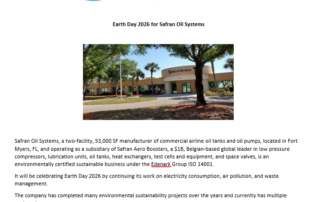
Earth Day 2026 for Safran Oil Systems
Safran Oil Systems, a two-facility, 53,000 SF manufacturer of commercial airline oil tanks and oil pumps, located in Fort Myers, FL, and operating as a subsidiary of Safran Aero Boosters, a $1B, Belgian-based global leader in low pressure compressors, lubrication units, oil tanks, heat exchangers, test cells and equipment, and space valves, is an environmentally certified sustainable business under the Edenark Group ISO 14001.
It will be celebrating Earth Day 2026 by continuing its work on electricity consumption, air pollution, and waste management.
The company has completed many environmental sustainability projects over the years and currently has multiple projects in process.
“For us, Earth Day is every day. We’re proud to have a team whose commitment is year-round,” said Mekki Kabbadj, Deputy General Manager of Safran Oil Systems; and who also oversees sustainability among his broader responsibilities.
“Safran Oil Systems is a pleasure to work with and is an example of what the world needs more of – an organization that produces a superior product, supports its current stakeholders, shows it cares about future generations via its commitment to sustainability certification, and optimizing financial performance due to its sustainability programs,” said David Goodman, CEO of Edenark Group.
Safran Oil Systems can be reached at https://www.safran-aero-boosters.com/
Edenark Group (https://edenark.com/ ) can be reached at +1.561.512.2257






“Climate Change is kicking our butts”
Per this article:
- March 2026 was the hottest March on record for the United States
- It was 9.35F hotter than average; the largest gap in history
- Nearly 20,000 temperature records were broken
- 2,000 new monthly temperature records were set
- January – March 2026 was the driest for the contiguous United States
- This summer, a strong El Niños could send global temperatures to new records
If we continue this path, it will not be a fun ride for us; and certainly not for our children.