Find and see the best corporate environmental sustainability news, posts and stories here, at Edenark Group’s “IN THE NEWS.” Let us know if you have environmental sustainability news you would like us to add.
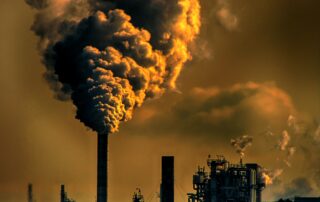
What does the Social Cost of Carbon mean for your business?
In the past few months, via recommendations from groups like the EPA, as shown in this article, the US government has established a 2% discount rate for the social cost of carbon.
- As background, a lower discount rate assigns more value to the harm that will come in future years and to future generations if climate change and carbon emissions are not addressed.
- London School of Economics economist Nicolas Stern, in 2006, assigned a discount rate of 1.4%, and the Trump administration, from 2016 – 2019, assigned a discount rate of 7%. In effect, Stern was saying, ‘We need to protect our children and their children’ and the cost is roughly $400 per metric ton of CO2 and Trump was saying, ‘I want to focus on today’ and the future cost is $1 per metric ton of CO2.
- You need to decide which view you are more comfortable with.
How does this translate to your business?
- At a 2% discount rate, the social cost of carbon is $190 per metric ton of CO2.
- As a rule of thumb, if your business rents office space and you are in the services arena (ie, you are not a heavy energy using manufacturer, or distributor or agricultural business), you are probably generating approximately 10 metric tons of carbon per full time employee, or $1900 in social carbon cost per employee. If you have 10 employees, and we use this rule of thumb, you are generating $19,000 in social carbon cost in 2023.
How do you turn this into a win?
- You will be hearing a lot about sustainability and carbon neutrality in 2023 and future years. The less we do today, the more someone else will be forced to do in future years.
- The good news is consumers want you to act and will reward those businesses that can prove they are part of the solution.
- Like all things, knowing where you are allows you to better decide where you are going. Formally quantifying your company’s carbon footprint gives you a starting point.
- If you then reduce your company’s carbon footprint, you are helping! Thank you!
- If you also want to turn this cost into a profit, you will need to convince consumers that you really did the things you say you did. To do that, you need to become environmentally certified sustainable and later, certified carbon neutral.
- If the above is of interest, follow the recommendations in this PPP.
Why the “S” in ESG is Super…Important for CFOs
Per this article in FEI, CFOs are giving more attention to the Social component of ESG because:
As to investors:
- There is a 71% increase, since 2018, in surveyed investors reporting the Social component of ESG as “important/critical” to their investment thesis.
- There is an 88% increase, since 2019, in surveyed investors reporting Social as “very important” to their long term success.
As to retaining existing employees:
- Roughly 50% of all employees say they will leave their current job if they can find a company that aligns with their environmental and social views.
- Given the cost of replacing employees is roughly 6-9 months of that position’s pay, not including intangibles like team bonding and workflow, keeping existing employees happy is a key objective.
As to finding new employees:
- Given that prospects want to work for companies that align with their views, having a robust ESG program helps a company attract top talent.
- Incorporating both environmental and social components accomplishes this.
As to stimulating the employees you have:
- Engaged employees contribute more significantly and companies that have robust ESG programs have more engaged employees.
- Again, to accomplish this, incorporating both environmental and social aspects is key.
If you are a small to mid-sized enterprise, let Edenark Group help you develop your ESG program and get your S to be Super.
BizCommunity – 3 Reasons why sustainability is a big deal for small business
This article highlights three key points that small businesses should consider when thinking about sustainability
- Your big-organization clients will demand it of you – Your large clients will become more aggressive in their supply chain requirement that vendors be legitimately (ie, certified) sustainable. Per the article – It’s vital for SMEs to get ahead of this trend and establish strong sustainability credentials, not just to avoid the risk of losing business, but also to have access to the growing number of opportunities that a demonstrable sustainability commitment will bring.
- Your customers expect it of you – Customers are no longer content with simply shopping for the cheapest product or service, they are becoming highly discerning in terms of where they are prepared to spend their money. They are choosing businesses that demonstrate a sincere commitment to using their resources to build a better world. Getting in front of this and being a company showing that it has listened and acted, is smart and profitable.
- It is not a cost, it is an investment in the future – Many smaller businesses still suffer under the misguided belief that being sustainable is simply too expensive. Unfortunately for them, the real cost of failing to integrate sustainability into their businesses is much higher than the relatively minor investment required to do so.
Speaking specifically to the last point, we have a 100% renewal rate – every year, 100% of our clients are choosing to go through the process of re-certification. They would not be taking the time or spending the money if it was not profitable for them. If done right, becoming certified sustainable delivers a positive ROI. Follow the recommendations in this PPP and you will be happy.

Sustainability now has a seat at the table
Per this article from Business Daily
- Climate change is a clear threat to societies around the world, with short, medium and long-term impacts on their livelihoods.
- Sustainability moved from the mainstream to become a global agenda item and is now a ‘must have’.
- Carbon trading and pricing are fast becoming a must-have for companies.
- Sustainability has and will continue to shape how companies have conducted business and create, retain and share value.
- Sustainability is now getting equal footing with financial performance and risk management.
- Sustainability reporting is now key for any business that has ambitions to play in responsible capitalism.
- Going forward, sustainability transparency and disclosures are going to be required for all, including SMEs, who should brace themselves to start sustainability reporting, including carbon emissions.
- With globalization, we are starting to see international policy affecting local companies.

Why do decisions in Japan matter to your company’s growth?
Edenark Group serves small to mid-sized enterprises (SMEs), which we define as an organization under $US1b at a location. This allows us to serve branches/divisions of multi-billion dollar, publicly-traded, parents.
But most of our clients are small, private, businesses. In many cases, with one employee.
So, an obvious question is – Why do we continue to post about the EU, or US, or now, Japan, deciding to implement laws that require public companies to report on sustainability and carbon neutrality?
We do it because an opportunity exists for SMEs before these laws require SME compliance.
The public companies that are now being required to report on sustainability and carbon neutrality are mandated by their sustainability and carbon neutrality commitments, to use vendors that can also prove they are sustainable and carbon neutral (ie, are certified). This filters down, directly and indirectly, to all companies.
These government regulations, triggering the large public company mandates, and combining with what we all know is being demanded by end-user-consumers, creates a tremendous opportunity for SMEs.
Given that less than 1% of SMEs are certified sustainable, those SMEs that wish to take market share, can differentiate from their competitive peers by becoming certified sustainable. The results, which we have been sharing with you via studies by many different groups, show certified sustainable companies growing 4x, 7x, 20x their non-certified peers.
This article talks about Japan joining the EU and US in requiring sustainability / ESG disclosures. This is three of the world’s top five economies and over 37% of the world economy. The UK already has programs in place and if we add it to the group, we are at 40% of the world economy committing to sustainability / ESG disclosures.
By the end of 2023 we will be over 50%.
The trickle down, which has become more like a flood over the past 12 months, will impact every company on the planet, no matter how small.
Every SME is seeing the same data, which we report on weekly – Certified sustainable companies are growing faster and the gap between certified sustainable companies and their non-certified competitive peers will continue to widen.
The decision should not be hard. You are doing the right thing for the planet, differentiating from your peers that are not as fast as you are, and growing faster. This PPP can show the way.
Why did we build the Edenark Group ISO 14001 Sustainability Certification Program?
In this article in Progressive Grocer, Jostein Solheim, currently EVP of Unilever, says “When I started in 2010 as CEO of Ben and Jerry’s, I was asked, ‘Why are you doing all this [sustainability] stuff?’ Now, it’s like, why aren’t they doing it? In 10 years’ time, the situation has flipped, and the reason is because consumers care, and they feel they can make a difference by buying the products that do better for the things they care about.”
With 7 out of 10 consumers now willing to move their business if they find a certified sustainable company that offers a similar product, Jostein saw where consumer demand and loyalty was headed.
This is why we built the Edenark Group ISO 14001 sustainability certification program for small to mid-sized enterprises (SMEs). We wanted to design a program that met the needs of the SME; giving them a cost-effective way to satisfy the demand of their consumer – to do the right thing for the environment – while also supporting the financial and operational needs of the company to grow and take market share.
This article explains why sustainability certification will help a SME stand out; and what a SME should consider when thinking of becoming sustainable.
Hinkle, Richter & Rhine, LLP, CPAs, has renewed its Environmental Sustainability Certification through 2023
Hinkle, Richter & Rhine, LLP, CPAs, a 40+ year old, full-service accounting firm, serving clients in South Florida and across the country, has continued its environmental sustainability commitment by renewing and extending its Edenark Group ISO 14001 sustainability certification through 2023.
The Edenark Group ISO 14001 is the world’s premier environmental sustainability certification program and allows SMEs (small to mid-sized enterprises) the ability to attain the world’s most popular environmental certification standard via a program designed and priced specifically for them. Edenark Group also helps clients pursue carbon neutrality and ESG compliance, using the Edenark Group ISO 14001 as a foundation for long term compliance.
The program, which allows companies to progressively improve at a pace that works for their needs, helps the organization define how it interacts internally, externally, and with the environment. It incorporates energy/waste/water, employee health and performance enhancement, community involvement, procurement and suppliers, compliance and regulations, emergency/security, and stakeholder engagement. Benefits include creating a culture of continual improvement, stakeholder engagement, lower costs, higher revenues and profits, improved employee performance, and…… doing the right thing for the environment and current and future generations.
“We care about the current and future needs of our clients, our employees, our vendors, and our community,” said Darryl Hinkle, Managing Partner of Hinkle, Richter & Rhine. “We have been certified for three years and are pleased with how it has impacted how we approach decisions. We are a stronger company because of it; along with being able to do our part for the environment.”
“In 2022, while also rebuilding from the impact of the pandemic, our team was able to complete a number of projects, including the complete retrofit of our office with LEDs, recycling of old equipment, elimination of Styrofoam cups, incorporation of 20% work from home, and continued reduction of paper in all aspects of our business. Further, the Green Team has an exciting list of projects scheduled for 2023,” added Hinkle.
“Edenark Group has a 25 year relationship with Hinkle Richter & Rhine and they are a wonderful example of what the world needs more of – an organization that produces a superior product, supports its current stakeholders, shows it cares about future generations via its commitment to sustainability certification, and makes more money due to its sustainability programs,” said David Goodman, CEO of Edenark Group. “When an organization executes the Edenark Group ISO 14001 sustainability certification, as Hinkle, Richter & Rhine is doing, it not only benefits the environment, but it also benefits its own operation,” added Goodman.
Hinkle Richter & Rhine can be reached at +1.954-941-2312
Edenark Group can be reached at +1 561.512.2257
Entrepreneur Magazine – 4 reasons Sustainability Will Benefit Your Business and Satisfy the Growing Trend of Green-Hungry Customers
Per this Entrepreneur Magazine article, nearly three-quarters of CEOs are prioritizing sustainability.
However, if you are running a small business, or even a start-up, with a thousand things pulling at you, is proving you are sustainable ‘worth it’?
Consider this:
Buyers are using sustainability as a yardstick
- 64% of consumers say they will pay more for sustainable products
- 78% of consumers are more likely to purchase environmentally-friendly products
- So, as a small company, with limited advertising and purchasing power, sustainability can be your marketing solution. This is a powerful differentiator, as consumers will move their business to companies that can prove (ie, become certified) they are sustainable
Employees want to work for sustainable companies
- 61% of Millennials (who are now 40!) list sustainability as a deciding factor in where to work
- 60% of Gen Z (up to 26 years old) will not apply to a company that has not proven it is sustainable
- Net, if your website cannot convince the visitor you are legitimately a sustainable company, you lose out on over half of them
Many private investors are funding sustainable startups
- As reported before, investors are more likely to support sustainable companies
- As reported before, sustainable companies are able to raise more money
- 78% of investors felt organizations should put sustainability above short-term profits
- Things always take longer than expected and it is nice when your investors are willing to grant you extra time, tied to your sustainability efforts
The world is hungry for green thought leaders
- Sustainability gives you a voice that no other topic can currently match
- Legitimately (ie, certified) sustainable companies are trusted and have credibility
- Think of how much money you would need to spend to replicate what sustainability can do for your brand
We suggest all companies considering sustainability to follow the recommendations in this PPP.


2023 Forecast for Sustainability / ESG – Five things to look for
This article forecasts five things to look for from sustainability / ESG in 2023. If you are a SME, focus on the first two. The first one will bring potential cost and the second one is a potential opportunity.
Full Lifecycle Funding – Expect the beginning of increased prices, taxes or escrow on materials, to cover the end-of-life costs associated with disposal and impact on the environment.
Consolidation of Supply Chains – If organizations become frustrated with their vendors not becoming sustainable and carbon neutral, they may be forced to remove that supply chain role and take that function internal – Read this one again and consider the risk and opportunity if you are a SME who is a vendor to a larger company.
Increased Pragmatism – Prioritizing industries for sustainability / carbon neutrality / net zero and a possible move away from China as a supplier
Greater Care in External Statements – In 2022, many companies went public with their sustainability / carbon neutral / net zero claims, with little/no support for same. Litigation on some of these will reduce the number of non-supported claims in 2023 and beyond.
More Litigation and Settlements – We will see more action and settlements tied to the above false claims and Greenwashing.
Safran Oil Systems has Become Environmentally Certified Sustainable under the Edenark Group ISO 14001 Program
Safran Oil Systems, a 36,250 SF manufacturer of commercial airline oil tanks, located in Fort Myers, FL, and operating as a subsidiary of Safran Aero Boosters, a $1B, Belgian-based global leader in lubrication units, oil tanks, heat exchangers, and special valves, has become environmentally certified sustainable under the Edenark Group ISO 14001 program.
The Edenark Group ISO 14001 is the world’s premier environmental sustainability certification program and allows SMEs (small to mid-sized enterprises) the ability to attain the world’s most popular environmental certification standard via a program designed and priced specifically for them. Edenark Group also helps clients pursue carbon neutrality and ESG compliance, using the Edenark Group ISO 14001 as a foundation for long term compliance.
The program, which allows companies to progressively improve at a pace that works for their needs, helps the organization define how it interacts internally, externally, and with the environment. It incorporates energy/waste/water, employee health and performance enhancement, community involvement, procurement and suppliers, compliance and regulations, emergency/security, and stakeholder engagement. Benefits include creating a culture of continual improvement, stakeholder engagement, lower costs, higher revenues and profits, improved employee performance, and…… doing the right thing for the environment and current and future generations.
“We are best of class in aircraft engine oil tanks development and production and accept the responsibility of leading this effort that will make a global impact,” said Jean-Pierre Posset, General Manager of Safran Oil Systems. “Our organization, including our employees in Florida and the rest of the world, cares deeply about the environment and sustainability. We are excited to receive this certification and join the others around the world that have chosen to be part of the solution.”
“When an organization pursues, and attains, the Edenark Group ISO 14001 sustainability certification, they are not just doing it to see their costs go down and revenues and profits go up. They are setting a higher bar for their organization and sending a signal to all those around them,” says David Goodman, CEO of Edenark Group. “They are agreeing to adhere to the world’s Gold standard for sustainability certification; are choosing to be a leader and part of the solution, not the problem; and are joining an elite fraternity of over 300,000 organizations, in over 150 countries, that have committed to continually improving in every way.”
Safran Oil Systems can be reached at https://www.safran-aero-boosters.com/
Edenark Group (https://edenark.com/ ) can be reached at 561.512.2257